When planning a turbo engine build, it’s easy to focus on turbocharger selection, boost targets and supporting modifications. But if you’re also rebuilding the engine’s bottom end, connecting rods deserve attention.
Connecting rods transfer force between the pistons and crankshaft. They must handle combustion loads as well as the forces created by piston movement. Choosing the right rods involves more than selecting a particular design. Fitment, materials and the intended use of the engine all matter.
If you’re still planning the wider setup, our guide to All Parts You Need to Turbo Your Car covers the main components of a turbo system.
Understand the Loads Inside a Turbo Engine
A turbocharger allows more air into the engine, supporting increased fuel delivery and potentially greater torque. Higher cylinder pressure can place greater compressive loads on the connecting rods, but boost pressure alone doesn’t determine those loads.
Compression ratio, combustion conditions and engine tuning also play a role. At higher RPM, the rods and their fasteners must withstand increasing inertial forces as the pistons accelerate and decelerate.
That’s why connecting rods should be selected with the engine’s intended torque, operating RPM and overall configuration in mind—not just a boost target or horsepower figure.
Match the Rods to Your Pistons and Crankshaft
Once you’ve decided to replace the connecting rods, start with compatibility. Identify the exact engine variant and check the specifications of the components you plan to use.
Key dimensions and specifications include:
- Center-to-center length: Affects the relationship between piston position and crankshaft geometry.
- Big-end bore and width: Must suit the crankshaft journal, bearing arrangement and required clearances.
- Small-end bore: Must be compatible with the wrist pin and piston design.
- Rod bolt specifications: Determine the appropriate fastener installation requirements.
These specifications need to work together. Connecting rods designed for one engine variant may not fit another, even when the engines have similar names or displacements.
If you’re using aftermarket pistons or a different crankshaft, confirm the compatibility of the complete rotating assembly before ordering.
Look Beyond H-Beam vs. I-Beam
H-beam connecting rods are commonly used in performance engine builds, including turbocharged applications. However, beam shape alone doesn’t determine a rod’s strength or suitability.
Material, manufacturing process, geometry, weight and fastener specifications also matter. An H-beam design isn’t automatically stronger than every I-beam alternative.
For more on the differences, see our H-Beam vs. I-Beam Connecting Rods guide.
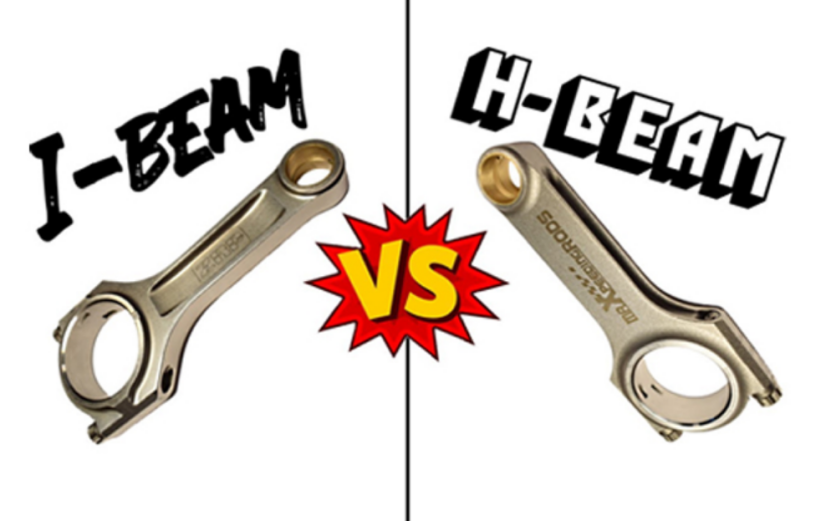
MaXpeedingrods offers H-beam connecting rods for a range of engine applications. When comparing options, check the listed engine compatibility, dimensions, material and rod bolt specifications.
The right connecting rods should fit your engine, work with the rest of the rotating assembly and suit your intended use. Proper installation and clearances are just as important as the rods themselves.
Explore MaXpeedingrods H-Beam Connecting Rods to find options for your next engine build. Be sure to verify the individual product specifications before ordering.